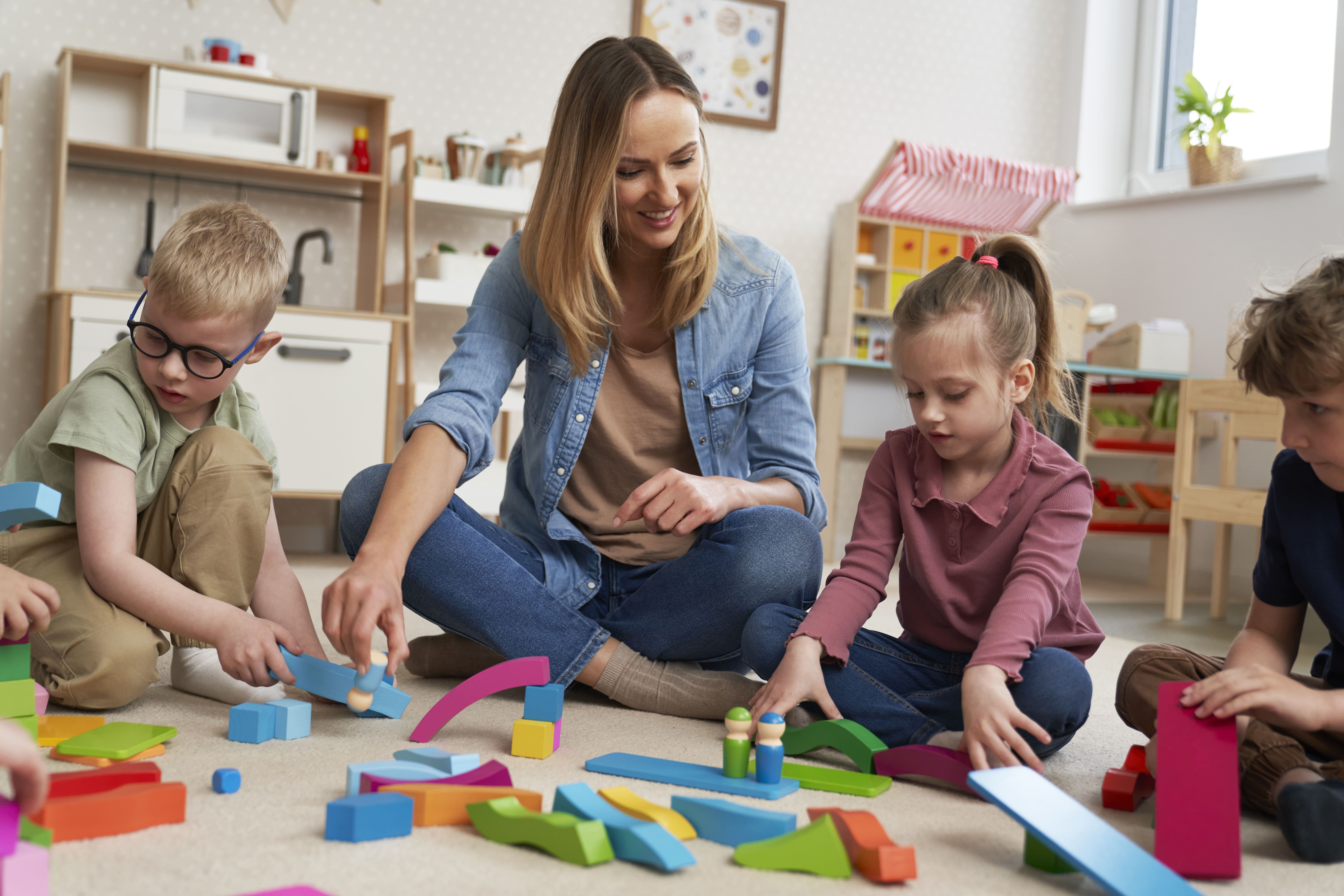
Toy disinfection in daycare refers to all practices aimed at eliminating viruses, bacteria, and fungi present on objects handled by multiple children, in order to break the transmission chains inherent in group living. In daycares, where toddlers naturally put objects in their mouths and constantly share games and toys, this step of the hygiene protocol is as essential as it is time-consuming for the teams.
Summary:
- Why shared toys are a major contamination point in daycare ?
- The classic cleaning protocol and its limits in daycare
- How to reduce washing frequency without increasing health risk?
- The Novven 3 disinfecting cabinet for early childhood
- Comparative table: toy disinfection methods
Why shared toys are a major contamination point in daycare ?
In a collective space like a daycare, a toy passes on average through the hands and often the mouth of multiple children over the course of a single day. This close proximity is identified as a decisive factor in the circulation of infectious diseases among young children, with daycares constituting a particularly favorable breeding ground for transmission.
The figures give a measure of the phenomenon. According to the High Authority for Health (Haute Autorité de santé), acute rotavirus gastroenteritis is responsible each winter in France for approximately 57,000 general practice consultations, 28,000 emergency room visits, and 20,000 hospitalizations. Yet these viruses are not only transmitted by direct contact: they can remain active for up to four hours on hands, and several days or even weeks on objects and surfaces. An undisinfected toy therefore becomes a delayed-action vector of contamination.
In view of this finding, the High Council for Public Health (Haut Conseil de la santé publique) has formalized specific recommendations on the management of toys and cleaning/disinfection in establishments such as daycares.
The classic cleaning protocol and its limits in daycare
In practice, health recommendations generally translate into a differentiated protocol depending on toy usage: daily maintenance for toys put in the mouth, weekly for others. In detail, methods also vary according to materials:
- Immersible toys (rigid plastic): 15-minute soaking in a detergent-disinfectant solution compatible with food use, twice a week, followed by complete rinsing and drying.
- Stuffed animals and fabric toys: Machine washing at 40°C minimum, at least once a week.
- Dishwasher-compatible rigid surface toys: Machine run, with no additional disinfection required.
This protocol works, but it has a real cost for the teams: time spent soaking, rinsing, air drying, and managing toy rotations to never leave a section without available equipment, tasks that add to the day and distract staff from their primary mission: welcoming children.
How to reduce washing frequency without increasing health risk?
The question is therefore not to disinfect less, but to disinfect better. The challenge for daycares is to find solutions that guarantee the same level of hygiene, or even a superior level, while reducing the time and mental load represented by repeated manual toy cleaning.
This is precisely the objective of the JVD Prevention range: to offer equipment that automates and secures the maintenance of PPE or everyday objects without multiplying manipulations. At JVD, this approach is based on a simple principle: act upstream to disinfect and dry in a single cycle, rather than chaining soaking, rinsing, and air drying.
The Novven 3 disinfecting cabinet for early childhood
The Novven 3 disinfection cabinet is the JVD solution dedicated to early childhood. It allows wood, plastic, cardboard, or fabric to be disinfected all at once, without water, chemicals, or detergent. Its process, certified by two independent laboratories (VirHealth and the Laboratory for Environment and Food of Vendée), displays a virucidal, bactericidal, and fungicidal power greater than 99.999%, compliant with standard EN 17272.
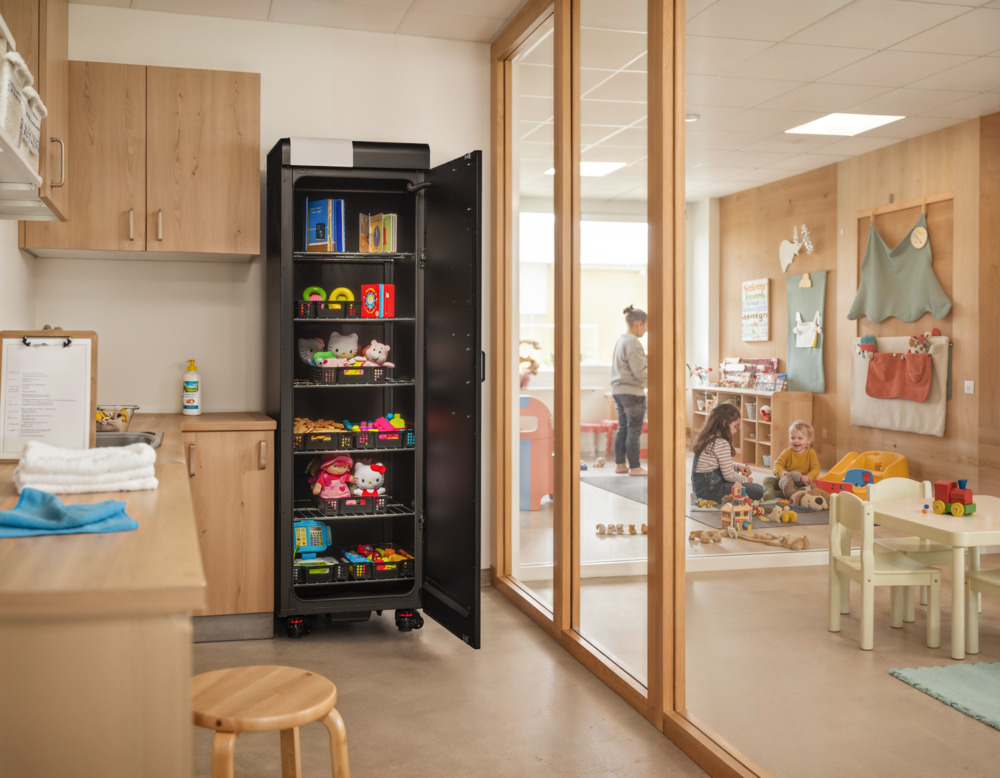
Concretely, in daycare settings, this translates into:
- Measurable time savings: Between 1 hour and 1.5 hours per day usually devoted to manual toy disinfection are freed up to welcome children, a benefit confirmed by the Alys association, which equipped its 16 daycares with Novven 3S cabinets and noted a savings of about 30 minutes per day per structure.
- A lighter mental load for teams, who no longer have to sort or monitor soaking or rinsing times: all objects are entrusted to the cabinet in a single gesture.
- A reduction in contamination risks, for both children and staff, with a positive impact on absenteeism linked to seasonal epidemics.
- Extended equipment lifespan: At Alys, wooden and fabric toys, usually renewed every 3 years, see their lifespan doubled thanks to rapid drying which limits the humidification of the material.
Comparative table: toy disinfection methods in daycare
| Method | Recommended frequency | Time per cycle | Chemicals | Team burden |
| Manual soaking (immergeable toys) | 2x/week | 15 min soaking + rinsing + drying | Yes (detergent-disinfectant) | High: monitoring, rinsing, drying |
| Machine washing (stuffed animals, fabrics) | 1x/week minimum | 40°C cycle + drying | Yes (detergent) | Moderate: sorting, loading, cycle time |
| Dishwasher (rigid toys) | According to usage | Standard cycle | Yes (dish soap) | Low to moderate |
| Novven 3 disinfecting cabinet (JVD) | According to toy rotation | 45 min (complete cycle: disinfection + drying) | No (waterless, chemical-free) | Low: loading in one go, unattended |
Are you interested
in our products?
Need information or expert advice?
Let’s discuss it via video call or phone.
Frequency depends on usage: daily for toys regularly put in the mouth, weekly for others. This frequency must be increased during epidemic periods.
For immersible toys not machine washable, the classic protocol recommends a 15-minute soak in a food-safe detergent-disinfectant solution, followed by careful rinsing and drying. A disinfecting cabinet like Novven 3 makes it possible to treat these same toys, as well as wood, cardboard, and fabric, in a single cycle.
Yes: certain bacteria responsible for gastroenteritis remain active for several days or even weeks on inert objects and surfaces, which justifies regular disinfection and not just simple cleaning with soapy water.
It does not replace routine maintenance (removal of visible soil), but it advantageously replaces the most time-consuming manual disinfection steps (soaking, rinsing, drying) by grouping them into an automated, chemical-free cycle.
Beyond the Novven 3 cabinet, JVD offers air purifiers and contactless hand disinfection stations, detailed on the dedicated daycare page.