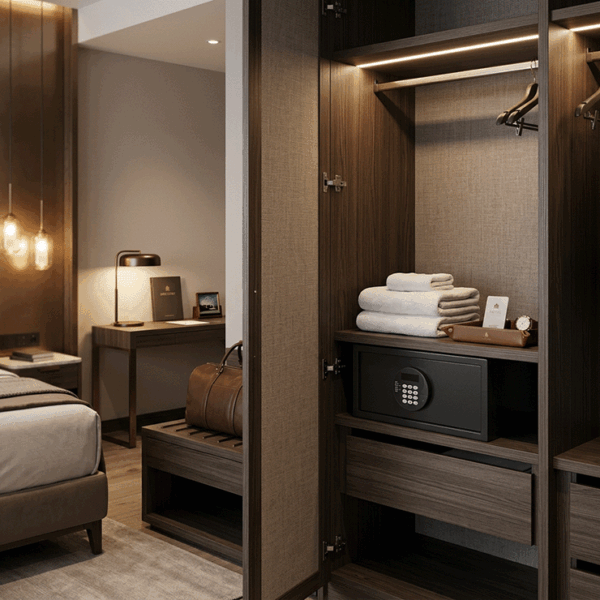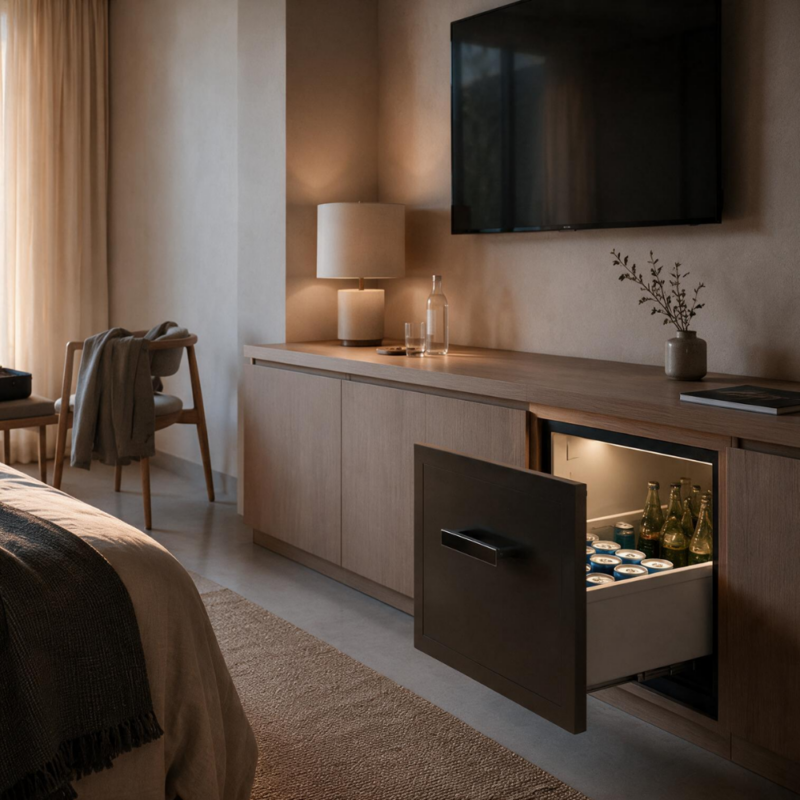
In a hotel room, the minibar is a discreet piece of equipment that contributes to guest comfort. For the property, choosing one also means taking very concrete criteria into account: energy consumption, noise level, capacity, ease of maintenance and installation constraints. These are precisely the points on which JVD, a manufacturer of hotel room equipment, designs its range of minibars, built to meet hoteliers’ day-to-day requirements.
So, which minibar should you choose for a hotel? This guide covers the main criteria to consider, the differences between technologies and available formats, and the points to check in order to select equipment suited to your property. Throughout the sections, you will also find the solutions JVD offers to equip your rooms.
Table of contents
1. Why install a minibar in a hotel room?
A minibar allows guests to enjoy drinks and refreshments without having to leave their room. It can therefore contribute to a comfortable stay and complement the services offered by the hotel.
For hoteliers, the challenge is to choose equipment that fits easily into the room and is suitable for hotel use. A minibar should operate discreetly, be easy to maintain and meet the establishment’s requirements in terms of capacity and electricity consumption.
It is also important to consider how the minibar will be used: as a self-service amenity, with complimentary products, or as part of a paid offering. These choices influence the format, interior layout and ease of access to the products.
2. Is a minibar compulsory in a hotel?
It depends on the hotel’s star rating. The hotel classification table for tourist accommodation (order of 29 December 2021, published by Atout France) sets out mandatory and optional criteria, depending on the number of stars.
- From 1 to 4 stars: a minibar is an optional criterion that earns points under the à la carte system.
- 5-star hotels: a minibar is compulsory. It must be clean, in working order and contain at least 3 ranges of beverages and 3 ranges of food products.
The same criterion applies to the Palace distinction. These requirements influence the choice of equipment: in a 5-star hotel, the capacity and interior layout must allow for a sufficiently varied selection.
Beyond hotel classification, a minibar remains an added comfort amenity.
3. What criteria should you consider when choosing a minibar?
Before comparing models, it is useful to define the establishment’s needs. Several criteria can help guide your choice.
- Energy consumption: compare the specifications of different models and consider their cooling technology.
- Noise levels: choose an appliance suitable for a hotel room, where acoustic comfort is important.
- Capacity: select a volume that matches the number of products offered and the available space.
- Format: check that the minibar can be installed in the intended location, particularly inside a piece of furniture.
- Maintenance: make sure the interior and accessible components can be cleaned easily.
- Durability: review warranty conditions, spare parts availability and maintenance arrangements.
Energy consumption deserves particular attention in establishments with a large number of rooms. To estimate the impact of a minibar fleet, it is useful to compare the appliances’ energy consumption data and consider them under the hotel’s actual operating conditions.
4. Which cooling technology should you choose?
Cooling technology affects how a minibar operates, its noise levels and its electricity consumption. The main technologies used are compression, absorption, thermoelectric cooling (the Peltier effect) and thermo-absorption. Their characteristics differ, so it is important to compare the technical specifications of each model rather than relying solely on its appearance or capacity.
At JVD, the technology varies depending on the model. For example, the 40 L drawer minibar uses thermo-absorption, while the 50 L drawer minibar uses Smart Compression.
The choice of refrigerant is also part of a broader regulatory framework. The European F-Gas Regulation (EU) 2024/573 governs fluorinated greenhouse gases and provides for their gradual reduction. However, this framework alone is not enough to determine which minibar is suitable for an establishment: it is still necessary to compare the technical specifications and the hotel’s needs.
Consult the EU F-Gas Regulation.
5. Which format and capacity should you choose?
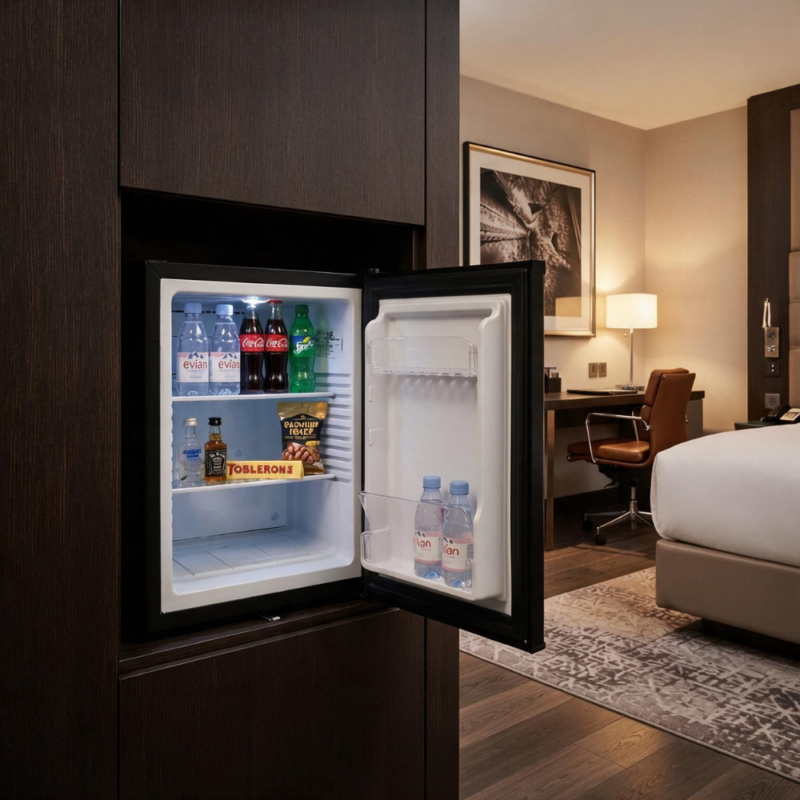
The choice of minibar depends on the room layout, the intended installation location, the desired visibility of the products and the required capacity. JVD offers solid-door, glass-door and drawer models, with capacities of 30 L, 40 L and 50 L.
| Format | Best suited to situations where… |
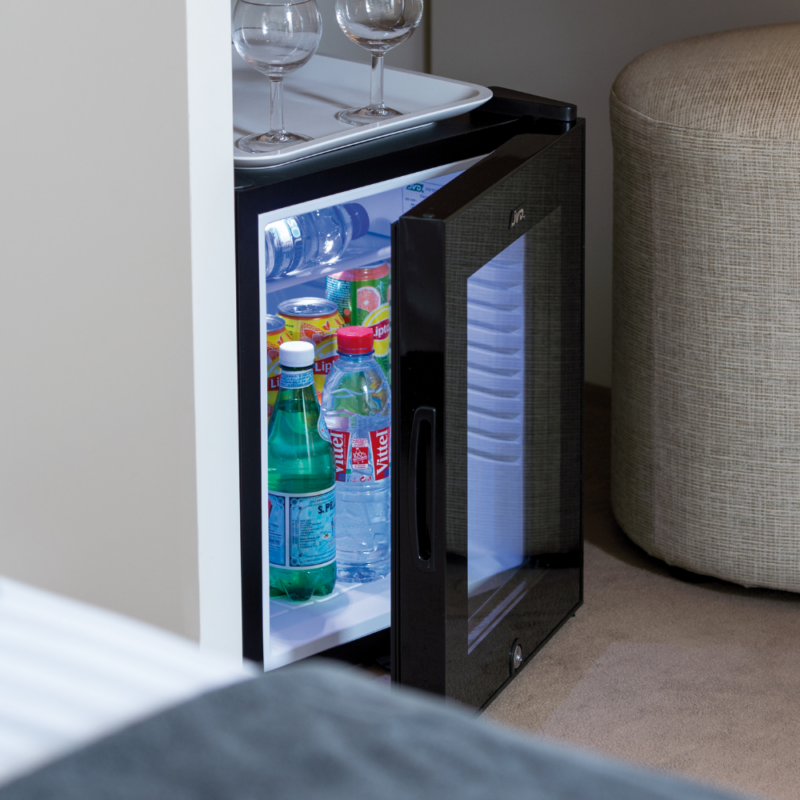
| Solid door | You want the contents to remain discreet. |
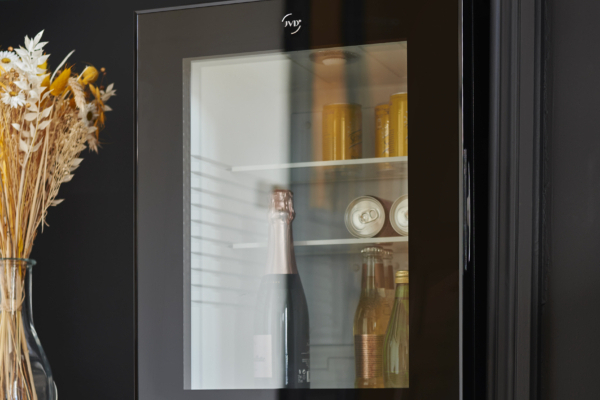
| Glass door | You want products to be visible and easy to identify. |
| Drawer | Your layout includes a low or integrated installation space. |

Solid-door thermo-absorption minibars
Available in 30 L and 40 L versions.

Glass-door thermo-absorption minibars
Available in 30 L and 40 L versions.

Drawer thermo-absorption minibars
100% accessible.
6. How to integrate a minibar into a hotel room?
Minibar installation should be planned from the design or renovation stage of the room. Its location should allow guests and housekeeping staff to access it easily, without obstructing movement or reducing the available space.
When a minibar is integrated into a piece of furniture, it is important to check its dimensions and follow the manufacturer’s installation instructions, particularly regarding ventilation and the space required for proper operation. An accessible power outlet should also be provided, along with a location that facilitates maintenance.
Proper installation helps maintain the appliance’s performance, simplify maintenance and ensure seamless integration into the room’s design.
Interested in our products?
Whether you need product information or expert advice, feel free to contact us to arrange a video call or telephone conversation.
7. FAQ
Under the French hotel classification system, a minibar is compulsory for 5-star establishments. For hotels rated from 1 to 4 stars, it is an optional criterion.
The choice depends on the available space, the desired format, the required capacity and the cooling technology. The JVD range offers several formats and capacities to suit different room layouts.
JVD minibars are designed to minimise noise in hotel rooms. Thermo-absorption models operate silently 24 hours a day. The 50 L drawer minibar with Smart Compression offers programmable silent operation during periods when the room is occupied.
The JVD range includes 30 L, 40 L and 50 L minibars, depending on the format and model.
Depending on the model, JVD minibars use thermo-absorption or Smart Compression. The relevant models use R600a (isobutane) as a refrigerant.
Our minibars consume 66% less energy than traditional compression systems. In a 100-room hotel, this represents annual savings of €8,000 to €12,000.