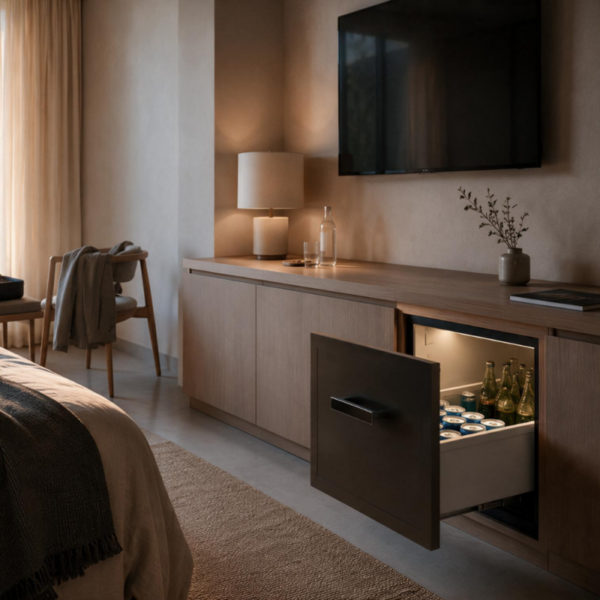
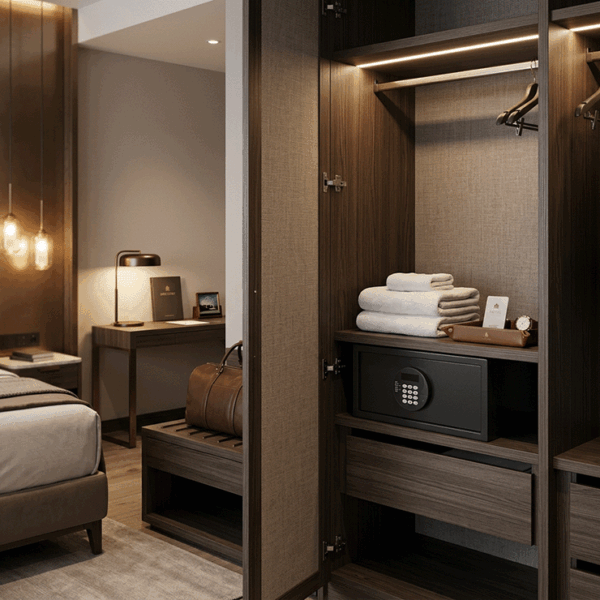
A hotel safe allows guests to secure their personal belongings directly in their room: passport, cash, jewelry, laptop, or important documents. To choose the right model, you mainly need to consider the room layout, the available furniture, the type of opening, the capacity, the security level, and how easy it is for hotel staff to manage.
A top-opening safe, also called a top-loading safe, is ideal for discreet installation in a drawer. A side-opening safe is better suited to installation in a wardrobe, closet, or standard hotel furniture piece.
Contents
1. Why Install a Safe in a Hotel Room?
Installing a safe in a hotel room enhances perceived security, guest comfort, and overall service quality. Travelers wish to secure their valuables whenever they leave their room: passports, payment methods, cash, jewelry, tablets, laptops, or business documents.
For hotel operators, in-room safes also present operational benefits. They reduce deposit requests at the front desk and empower guests with autonomy during their stay. While unobtrusive, in-room safes are an essential amenity in the hospitality experience, particularly for international clientele, corporate travelers, and upscale or luxury properties.
Furthermore, hotel safes foster mutual trust between guests and the establishment. By providing a dedicated in-room security solution, hoteliers demonstrate proactive service and facilitate their stay.
2. What is a Top-Opening Safe?
A top-opening safe features a door that opens from above. This format is also commonly referred to as a top-load safe or top-open safe.
This configuration is particularly suited for installation within a drawer or lower cabinetry. Once integrated into the furniture, the safe remains discreet while remaining easily accessible. Guests can store their personal belongings from the top without needing to open a front door.
Top-opening safes are recommended for hoteliers seeking to optimize space, equip compact rooms, or maintain a minimalist decor. They are equally suitable for properties wishing to avoid a prominent safe inside a wardrobe or closet.

The JVD Iconic safe caters directly to this use case. Its ultra-slim profile enables drawer integration, offering sufficient capacity for guest valuables, including laptops up to 15 inches.
3. What is a Front-Opening Safe?
This configuration is particularly well suited to standard rooms, renovation projects, and establishments that already have furniture designed to accommodate this type of equipment. The front-opening design is easy for guests to understand and provides direct access to the items placed inside.
A side-opening safe is one whose door opens from the front. It is the most common format in the hospitality industry, because it fits easily into a wardrobe, a closet, or existing bedroom furniture.

JVD has designed several models to meet the needs of hotel properties, including the Fortress, Guardian, and Trustee series. They are designed to combine security, ease of use, and discreet integration into guestroom furniture. Selected models also feature operator-focused functionality such as backlit keypads, audit trails, or emergency override solutions.
Front-opening safes represent a dependable and versatile solution for securing guest property while adapting to the majority of room configurations.

Fortress
Engineered for standard guestrooms with a straightforward, reliable, and functional solution. Its front opening enables easy integration into a wardrobe or hotel cabinet.

Guardian
Suitable for properties seeking a comprehensive solution, featuring code or card locking, security master key, and operational history via a handheld decoder unit.

Trustee
Meets the needs of rooms with limited available space, delivering a practical security solution for guest valuables.
4. Comparison Table: Top-Opening vs. Front-Opening
| Criteria | Top-Opening Safe | Front-Opening Safe |
| Opening Mechanism | Door opening from above | Door opening from the front |
| Ideal Installation | Drawer or low furniture unit | Wardrobe, closet, or enclosed cabinet |
| In-Room Discretion | Very high | High |
| Space Saving | Excellent for compact rooms | Good if front clearance is available |
| Guest Access | Access from above | Access from the front |
| Recommended Use | Compact room, design hotel, discreet furniture | Standard room, renovation, classic furniture |
| Items Secured | Passport, jewelry, documents, laptop (model dependent) | Passport, cash, jewelry, documents, laptop (model dependent) |
| Key Advantage | Discreet integration into furniture | Simplicity and versatility |
| JVD Example | Iconic | Fortress, Guardian, Trustee |
5. What criteria should you check before choosing a hotel safe?
- The first criterion to check is capacity. A hotel safe must be able to hold the items guests most commonly want to protect: passport, cash, jewelry, tablet, documents, and sometimes a laptop. For business travelers, compatibility with a 14- or 15-inch laptop can be a real advantage.
- The second criterion is the locking system. A good hotel safe should be easy for guests to use, with a code that is simple to set. Depending on the model, it may also offer card-based locking, an emergency key, or a control unit for authorized staff to intervene.
- Security is also essential. It is recommended to choose a model with features suited to hotel use: lockout after several failed attempts, an anti-tampering mechanism, a low-battery alert, or a secure emergency opening system.
- Ease of use should not be overlooked. A backlit keypad, a clear display, or interior lighting make the safe easier for guests to use, even in a dimly lit room.
- Finally, hoteliers must think about maintenance. A safe used by different guests every day must be reliable, simple to manage, and easy to unlock in case of a forgotten code or a drained battery.
6. Where Should You Install a Safe in a Hotel Room?
A hotel safe must be installed in a place that is accessible, discreet, and secure at the same time. The most common locations are the wardrobe, the closet, a closed cabinet, a drawer, or a low piece of furniture designed for this purpose.
For a top-opening safe, installation in a drawer is particularly well suited. This configuration keeps the room uncluttered while giving guests quick access to their personal belongings.
For a side-opening safe, installation in a wardrobe or closed cabinet remains the most common solution. You simply need to leave enough space in front of the safe to open the door properly and use the keypad comfortably.
In all cases, the safe must be properly secured and integrated into the furniture to limit the risk of it being torn out, mishandled, or moved.
7. How should you handle forgotten safe codes and staff interventions?
In a hotel, forgotten codes are a frequent occurrence. A guest may forget their code, leave the property without opening the safe, or report a drained battery. It is therefore important to choose a safe designed to be managed easily by staff.
Models suited to the hospitality industry may offer emergency opening by key or by control unit. The JVD control unit for safes, for example, makes authorized interventions easier on compatible safes.
For Fortress models, the Fortress safe Smart Key allows emergency opening or recharging if a guest has forgotten their code or the battery is low.
An operation history is also an advantage for hotels. It lets you check the dates and times the safe was opened, which helps with follow-up in the event of a dispute or a guest request.
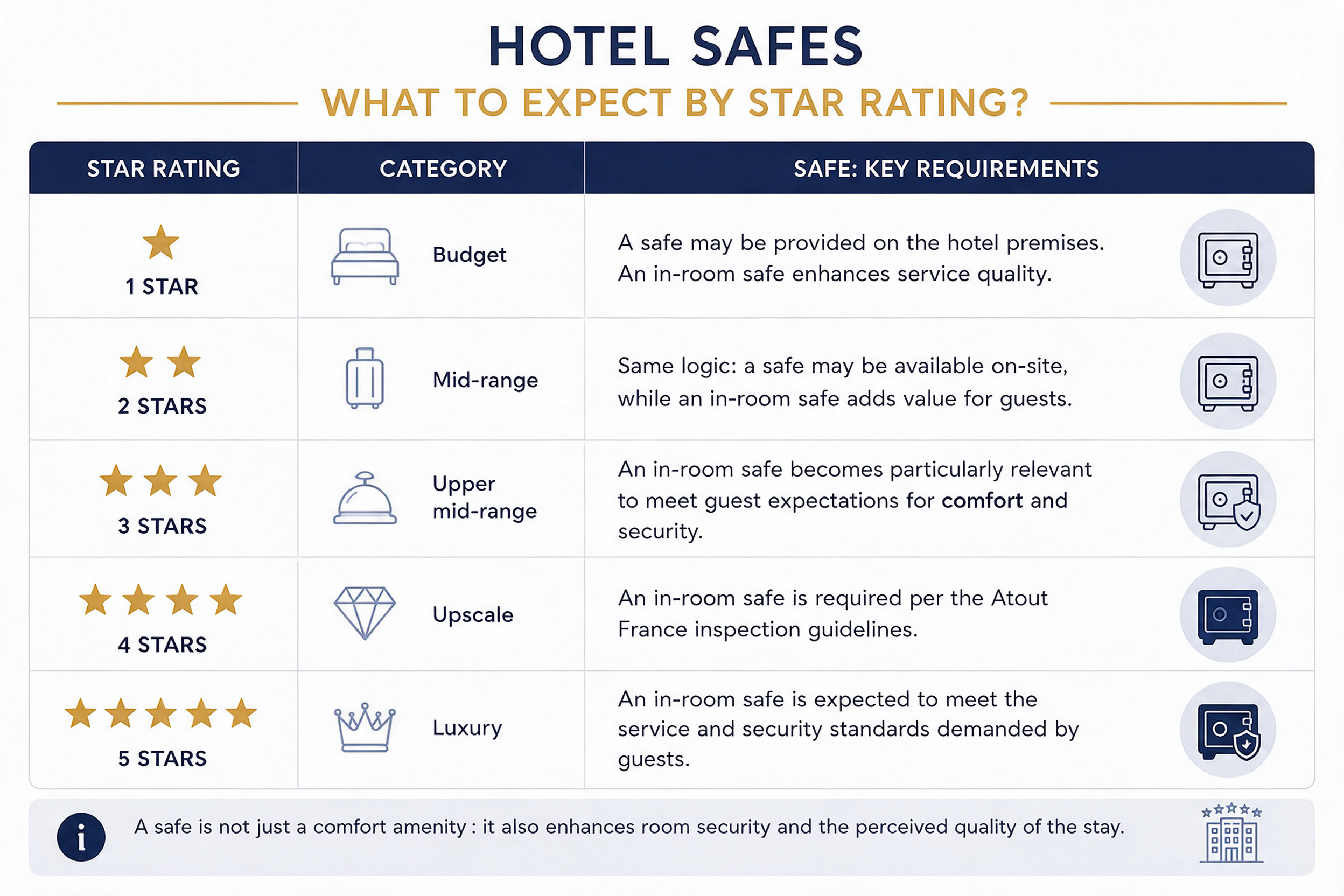
8. Hotel safes and hotel star ratings
Hotel classification is not mandatory: it is requested by the operator and organized from 1 to 5 stars according to criteria relating in particular to the comfort of the facilities, the services offered, the environment, and the welcome of guests with disabilities.
In this context, the safe should not be seen as a mere accessory. It contributes to the perceived quality of the stay, to guests’ peace of mind, and to the level of service the property offers. To learn more, you can consult the official page on the classification of tourist hotels.
For a hotel undergoing renovation, an upgrade project, or an harmonization of equipment, installing reliable, easy-to-use safes can therefore help strengthen the guest experience.
Safes and the hotelier’s liability
The security of personal belongings is also a sensitive subject in the relationship between a hotel and its guests. The French Civil Code provides that hoteliers are liable, as depositaries, for the clothing, luggage, and items brought into their establishment by travelers staying with them.
Article 1953 of the Civil Code also governs the hotelier’s liability in the event of theft or damage, with limits depending on the circumstances. To read the official text, you can refer to the Légifrance page on the hotelier’s liability for theft or damage.
Without replacing the property’s internal procedures, an in-room safe offers guests a simple way to secure their personal belongings during their stay.
9. Which JVD safe should you choose for your property?
Choosing a hotel safe is not only about comparing dimensions or a locking system. The type of opening is a central criterion, because it determines where the safe goes, how accessible it is, and how it fits into the room.
A top-opening safe is ideal for a discreet installation in a drawer or low piece of furniture. A side-opening safe is better suited to a wardrobe, a closet, or a standard hotel cabinet.
In both cases, it is essential to favor a solution that is simple to use, secure, reliable, and easy for staff to manage. By equipping your rooms with safes designed for the hospitality industry, you improve your guests’ peace of mind, make your staff’s work easier, and strengthen the perceived comfort of your property.
Discover the JVD safe range to find the solution best suited to your hotel rooms.
Interested in our products?
Whether you need product information or expert advice, feel free to contact us for a video call or a phone call.
A top-opening safe is a model whose door opens from the top. It is often installed in a drawer or low cabinet to remain discreet within the guestroom.
There is no difference: both expressions designate the exact same type of safe (also referred to as top-open).
The choice depends on available space and furniture. A top-opening JVD safe is suited for a drawer, whereas a front-opening safe is better suited for a wardrobe or enclosed cabinet.
Safes can be installed inside wardrobes, closets, cabinets, or drawers. Key considerations are guest accessibility, visual discretion, and secure fixing.
Hotel classification is optional, but an in-room safe may form part of expected amenities according to the comfort level and category of the establishment. Check applicable criteria for your project.
For corporate guest profiles, select a safe specification compatible with laptops up to 15 inches. JVD models such as Iconic, Fortress 15″, and Guardian cater directly to this use case.
Choose a safe featuring emergency overrides via master key, handheld decoder unit, or dedicated smart key. This allows authorized teams to intervene quickly in case of a forgotten code or depleted battery.